Dreyfus Accused
Read through a translation of the famous text J’Accuse! and answer questions based off of the text. Students will learn about bias, perspective, and the construction of history.
Relationship of People and Groups
Explore the creation of the Nuremberg Race Laws and what the significance of their implementation into society meant for the future of Jews in Germany.
The Nuremberg Race Laws aimed to define race and provide the framework for the systematic persecution of Jews in Germany.
Explain to students that the Nuremberg Laws were the first official step in systematic persecution of Jews in Germany. Creating this definition was not an easy task, it took years for German officials to agree on what being Jewish meant. This initial step in identifying and separating Jews from society was essential to carry out the persecution that followed.
Take the students through the resource, Nuremberg Race Laws by the US Holocaust Memorial Museum. With a partner, ask the students to go through the resource and take notes using the 3Ps method, jotting down what they find a) Profound b) Puzzling and c) Propelling.
In order to familiarize yourself, and your class with this model, please look over this guide: 3Ps: A Critical Reading Guide.
Have the pairs partner up with another group to form groups of four. As they gather in these groups, provide them with the following instructions:
Give students 20 minutes to complete these tasks and use the last 10 minutes to hear what the groups came up with for their questions.
This lesson meets the following Academic Standards required by the Wisconsin Department of Public Instruction.
Before you teach, use our teacher primer to freshen up on your content knowledge.
Students will watch a video by Yad Vashem explaining the Nazi ideology of race hierarchy. This lesson will open your students up to a discussion on race and the role it plays in society.
Nazi ideology pushed the need for racial purity and claimed that disobeying this would bring the destruction of mankind.
Begin by asking your students if they have heard of Darwin’s Theory of Evolution. What does it state? What was the theory applied to?
Show students a YouTube video titled, Key Historical Concepts in Holocaust Education: Race Doctrine by Yad Vashem. Before starting the video, give students the list of questions. Let them know they will have a chance to watch the video a second time.
Give students a few minutes to finish writing down their answers. Watch the video a second time if needed and then go over the questions as a class.
Divide the class into groups of four. Provide them with this quote by American novelist and winner of the Nobel Prize in Literature, Toni Morrison, “There is no such thing as race. None. There is just a human race – scientifically, anthropologically.”
In their groups, ask students to have a discussion with the questions below:
Reconvene as a class to open up the discussion. Were there any disagreements within the groups?
This lesson meets the following Academic Standards required by the Wisconsin Department of Public Instruction.
Before you teach, use our teacher primer to freshen up on your content knowledge.
Students will learn about anti-Jewish attitudes that pre-dates the Holocaust by centuries.
Anti-Jewish sentiment was rife for centuries before the Holocaust, particularly in historically Christian countries and empires. Jewish life was under constant threat of violence, to the point that sometimes entire Jewish communities were massacred.
Explain that historically, anti-Jewish sentiment was a common phenomenon in the Western, Christian sphere for over a millennia. Jews were often limited in their livelihoods and where they were allowed to reside. The medieval period in particular – a time of religious crusades and conquest – was full of anti-Jewish rumours, sentiment, and action. Jews were thought to be responsible for the crucifixion, and the idea of Blood Libel (Jewish slaughter of Christian children for religious rituals) was born. At the same time, ill-treatment of Jews was not always met with sympathy. Similar to today, there were people who disapproved of the hatred and violence they faced.
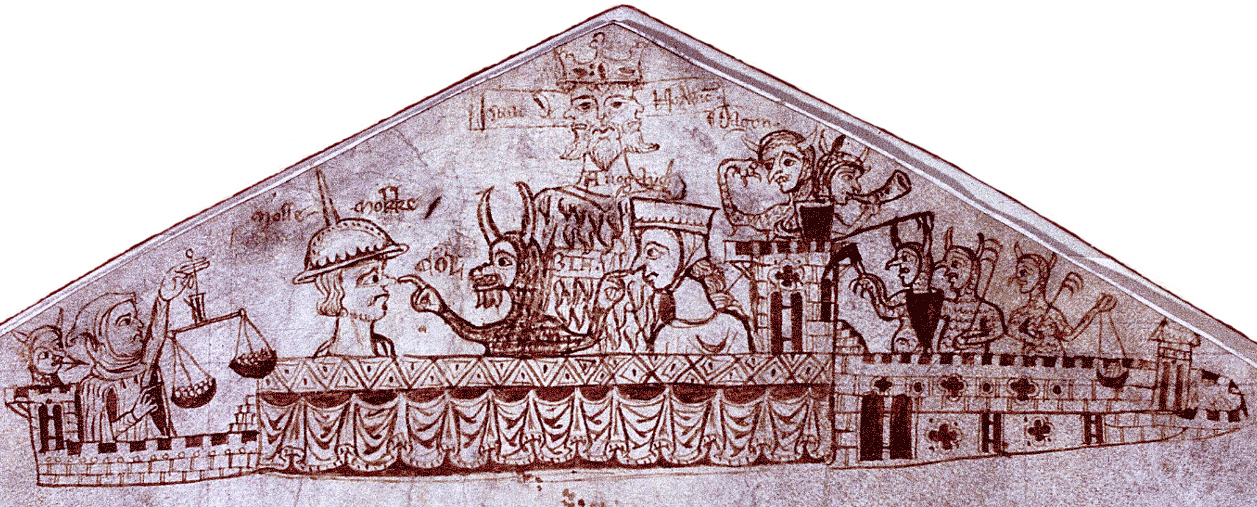
Share this image of a Medieval tax record with students. Tax records didn’t usually have pictures, but this one did. These records were documents that listed tax payments and this document records the payments made by Jewish people in the city of Norwich in Norfolk, England.
Lead the class in a short discussion about the image. Ask students what they see and what the various symbols might mean. This guide by the National Archives will help you to highlight certain aspects of the image. Help students to correctly interpret the image as anti-Jewish.
This lesson meets the following Academic Standards required by the Wisconsin Department of Public Instruction.
Before you teach, use our teacher primer to freshen up on your content knowledge.
This lesson centers on interviews of Alfons Heck who became a high-ranking member of the Hitler Youth. This lesson will allow students the opportunity to hear his recollection of Kristallnacht, or the “Night of Broken Glass.”
The desire for people to belong, coupled with unrelenting propaganda, aided by the belief that the Jews were inferior beings, led to actions being taken by some Germans to harm their former friends and neighbors.
Ask students what they might already know about Kristallnacht, “The Night of Broken Glass.”
Provide a brief overview of Kristallnacht with the students. Use the resource, Kristallnacht by the US Holocaust Memorial Museum Holocaust Encyclopedia article as a resource for this. You do not need to go over the entire article, merely use it as a reference to provide some background information.
Divide the class into groups and ask them to watch the video Confessions of a Hitler Youth.
Ask them to answer these questions:
This lesson meets the following Academic Standards required by the Wisconsin Department of Public Instruction.
Before you teach, use our teacher primer to freshen up on your content knowledge.
This lesson will help students understand the events of Kristallnacht and the different views and perspectives of those who witnessed it. This lesson will allow them to gain a deeper understanding of the varying human reactions to this violent pogrom against the Jews.
Those who witness injustice, without participation in the action, have the ability and the power to shape the consequences of those injustices through their response.
Ask students, “What happened on November 10, 1938?”
Show students the video, Kristallnacht: The November 1938 Pogroms by Facing History and Ourselves.
Divide the class into groups of three to five and assign a reading to each group.
Group 1: The Night of the Pogrom
Group 2: Opportunism during Kristallnacht
Group 3: A Family Responds to Kristallnacht
Group 4: Thoroughly Reprehensible Behavior
Group 5: A Visitor’s Perspective on Kristallnacht
Group 6: World Responses to Kristallnacht
Ask students to complete these steps after they read their group assigned reading as outlined in the Facing History lesson:
Once completed, pose the question again, “What happened on November 10th, 1938?” What can they now add to this question? Where did they get this information?
This lesson meets the following Academic Standards required by the Wisconsin Department of Public Instruction.
Before you teach, use our teacher primer to freshen up on your content knowledge.
This lesson summarizes the events leading up to, the event of, and the aftermath of Kristallnacht.
The Jewish people were abandoned by most of their fellow citizens and by those meant to protect them. Because of this Kristallnacht was a watershed moment which further ignited Hitler and the Nazi party’s intent to destroy the Jews.
Ask students what they might already know about Kristallnacht.
For the younger grades, or if the students are newly being introduced to Holocaust education, include some additional information. For example, tell students the name “Kristallnacht” is translated as “Night of Crystal” but is often referred to as the “Night of Broken Glass.” Some may know this name more than the official one. If they are not sure, have them guess what it could be based on the name.
Direct students to the resource, Kristallnacht by the US Holocaust Memorial Museum. Read through the document as a class. Start with the three key facts at the top of the page so students understand the main points as they go through the reading.
In a class discussion, go over the following questions:
Divide the class into groups of three to five and ask them to answer these questions about the reading. Ask students to take notes on their answers.
If time permits, come together as a class to go over the answers the groups came up with.
This lesson meets the following Academic Standards required by the Wisconsin Department of Public Instruction.
Before you teach, use our teacher primer to freshen up on your content knowledge.
Read a short text about the reality of life after the war in Displaced Person (DP) camps. Students will engage with the content by exploring a variety of questions about the post-war situation for Holocaust victims.
The process of rebuilding lives after the Holocaust was often long, painful, and arduous.
Lead a class discussion, asking students what they think of when they think of the word “home.” What does home mean to them?
Read the resource, Displaced Persons by Echoes & Reflections with the class, taking time to answer questions and clarify if necessary.
Take time to look at the statistics of Jewish DP’s in camps by 1946, pointing out that these were the majority of the survivors remaining in continental Europe from the population of about 10 million in 1933. Point out that many were forced to live in Displaced Person (DP) camps, often built within Nazi camp structures scattered across Europe.
Have students take 10-15 minutes to fill in their answers at the bottom of the resource they read by Echoes & Reflections. Once they finish, return as a class to go over their answers.
Lastly, return to the question of home. Has their idea of what home means changed from the start of the lesson?
This lesson meets the following Academic Standards required by the Wisconsin Department of Public Instruction.
Before you teach, use our teacher primer to freshen up on your content knowledge.
Watch the testimonies of Anna Heilman and Helen K., women who were imprisoned at Auschwitz and bravely resisted Nazism, each in their own way.
Even in settings engineered to create docile victims, Jewish prisoners found the strength to fight back.
Ask students how they define resistance. What does resistance look like and what form does it take? Ask them if they would expect there to be much resistance in extermination camps. Why or why not?
Show the video of Anna Heilman from Facing History and Ourselves. Preview the video by telling students that Anna’s story describes how the plot to blow up the crematoria at Auschwitz became a reality.
After the video concludes, ask students how they feel about this act of defiance? Was it successful?
Then, show the video of Helen K. from 19:52 to 25:50
Before beginning the video, ask students to record instances of resistance, however they define it.
After the video, ask students to share their responses, both written and felt, in small groups. What forms of resistance did they notice? What did they feel as they watched this testimony?
Finally, ask students to take a moment to write short responses to the question of whether these acts of defiance were successful or not. Given that most individuals died who tried to revolt, were their efforts in vain or meaningful? Why or why not?
Time permitting, open up for a broad class discussion.
This lesson meets the following Academic Standards required by the Wisconsin Department of Public Instruction.
Before you teach, use our teacher primer to freshen up on your content knowledge.
Experience the vitality and power of a song written and sung by prisoners in the Dachau Concentration Camp in southern Germany by inviting your students to critically evaluate its lyrics.
Self-expression is a powerful mode of resistance.
Ask students how they define resistance. What does resistance look like and what form does it take? Ask them also if they would expect there to be much resistance in concentration camps. Why or why not?
Printable background and lyrics here.
Listen to the Dachau Song via the US Holocaust Memorial Museum website. Ask them to pay attention to the tone and tenor of the song while they read along with the lyrics that pop up on the screen (full screen is best for this).
When the song is finished, prompt students to provide their initial thoughts about the song. What did they notice? Does it remind them of anything? What is the overall feeling that the song generated for them?
Then, distribute the PDF of the lyrics and the background information.
Read through the background information about the song and clarify any of the details or language that the students might have trouble with.
Then, split the class into 5 groups and assign each one to a verse or the chorus.
In groups, ask each team to analyze the lyrics that they have been given, offering that they can reference a dictionary to look up words that are more difficult.
Prompt their analysis with some questions that will help better understand what life was like in Dachau:
Ask each group to offer their analysis of the song and, while they do, add unique answers to your ‘chalk’ board. Once each group has presented their section, ask the whole group for other observations about the song in its entirety. What else can they glean from their collective observations about life in Dachau?
Time permitting, return to the recorded version of the song once again. Ask students to pay close attention to the lyrics that they have on their page in addition to the overall feel of the tune. What else comes up in their minds as they take in the whole piece once more?
This lesson meets the following Academic Standards required by the Wisconsin Department of Public Instruction.
Before you teach, use our teacher primer to freshen up on your content knowledge.
Watch a video detailing the steps taken to isolate Jews from German life. Open up into a conversation about the precursors the world should be on the lookout for when seeing human rights violations taking place around the globe.
Isolation and dehumanization, when not countered, allows for increasingly harsh treatments and injustices to take place.
Ask students, what is segregation? Have them come up with some examples of ways in which people can be segregated from one another. Open the class into a brief conversation about segregation by asking the questions below.
Pull up the video, From Citizens to Outcasts, by the United States Holocaust Memorial Museum. Introduce the video by reading through the context that can be found directly above the Discussion Question. Provide students with the question below prior to starting the video. While they watch, have students take notes to answer it.
How did Nazi Germany gradually isolate, segregate, impoverish, and incarcerate Jews and persecute other perceived enemies of the state between 1933 and 1939?
Reiterate to students that Nazi Germany took great measurers in order to dehumanize the Jews. Propaganda made them out to be enemies of the state. These tactics made many non-Jewish Germans take little notice or regard for the mistreatment and grave injustice that would continue against the Jews.
Divide the class into groups of five. Provide the groups with the instructions below. Give students the opportunity and time to research if necessary.
This lesson meets the following Academic Standards required by the Wisconsin Department of Public Instruction.
Before you teach, use our teacher primer to freshen up on your content knowledge.