Proclamation Inciting a Jewish Pogrom (1903)
Analyze an antisemitic document from 1903 to understand how the lie that Jews killed Jesus was used to incite violence against Jews.
Contextualization
Students will learn about the Warsaw ghetto uprising, the largest Jewish uprising in German-occupied Europe. This lesson will lead students into a discussion about resistance during the Holocaust and the many ways people resist today.
Despite the amount of energy it took to live day-to-day in the ghetto, some inhabitants formed organized resistance.
Begin by telling students that between 1941 and 1943 underground resistance movements began popping up in over 100 ghettos in Nazi-occupied countries. Triggered by the deportations and liquidation of the ghettos, many of these resistance groups staged uprisings in order to fight the Nazis or escape.
Ask students if they can list any ghetto uprisings that they have heard of before. Then explain that you will be taking a closer look at the uprising from the Warsaw ghetto.
Direct students to the resource, Warsaw Ghetto Uprising by the U.S. Holocaust Memorial Museum. Play the animated map video for the class before diving into the reading. Divide the class into groups of three or four and provide them with the instructions below.
In order to familiarize yourself, and your class with this model, please look over this guide: 3Ps: A Critical Reading Guide.
Come back together as a class and ask the groups to share what they had written down. Begin by asking groups to share what they found puzzling about the reading, is there anything that still needs to be cleared up?
Ask students to think of forms of resistance they have participated in or have seen or heard others do. Can they come up with any examples or instances where people took part in resisting, either violently or non-violently?
This lesson meets the following Academic Standards required by the Wisconsin Department of Public Instruction.
Before you teach, use our teacher primer to freshen up on your content knowledge.
Students will go through resources on antisemitism in the early modern era as well as a resource on the Nazi book burning of 1933.
Antisemitism and oppression has plagued the Jewish people for centuries. In the early modern era, and continuing on into Nazi rule, the Jews were kept from working certain jobs and often looked at in a negative light.
Ask students what it means to be an oppressed group. Can you think of some groups throughout history that faced oppression?
Walk students through the resource, Antisemitism in History: The Early Modern Era, 1300-1800 by the United Stated Holocaust Memorial Museum.
Then ask your students, why do people generalize characteristics for an entire group? How can this be dangerous? Take a few minutes to discuss this as a class before moving on.
Next, pull up the resource, Book Burning by the USHMM Holocaust Encyclopedia and go over the Critical Thinking Questions at the bottom of the page.
In groups of five, ask students to consider the following question:
This lesson meets the following Academic Standards required by the Wisconsin Department of Public Instruction.
Before you teach, use our teacher primer to freshen up on your content knowledge.
Students will read a short Anti-Defamation League article about antisemitism in the medieval period. They will then read, analyze, and present a short primary source detailing an act or written piece of antisemitism from the medieval period.
Anti-Jewish action and antisemitism was common in the Western world since the Classical era. As time passed, superstitions and suspicions about Jewish populations reinforced hatred and persecution that continues to affect Jewish populations today. The medieval period in particular saw violence toward, and persecution of, Jewish people – especially in Christian empires.
Ask students if they know what antisemitism is, and why it’s relevant today.
Read the sections of the article by the ADL on antisemitism throughout history titled “Islamic World” and “Medieval Christendom” as a class (a unit on antisemitism more broadly could use more of the article).
Lead a class discussion on the material. Ask students:
This lesson meets the following Academic Standards required by the Wisconsin Department of Public Instruction.
Before you teach, use our teacher primer to freshen up on your content knowledge.
Students will watch a video by Yad Vashem explaining the Nazi ideology of race hierarchy. This lesson will open your students up to a discussion on race and the role it plays in society.
Nazi ideology pushed the need for racial purity and claimed that disobeying this would bring the destruction of mankind.
Begin by asking your students if they have heard of Darwin’s Theory of Evolution. What does it state? What was the theory applied to?
Show students a YouTube video titled, Key Historical Concepts in Holocaust Education: Race Doctrine by Yad Vashem. Before starting the video, give students the list of questions. Let them know they will have a chance to watch the video a second time.
Give students a few minutes to finish writing down their answers. Watch the video a second time if needed and then go over the questions as a class.
Divide the class into groups of four. Provide them with this quote by American novelist and winner of the Nobel Prize in Literature, Toni Morrison, “There is no such thing as race. None. There is just a human race – scientifically, anthropologically.”
In their groups, ask students to have a discussion with the questions below:
Reconvene as a class to open up the discussion. Were there any disagreements within the groups?
This lesson meets the following Academic Standards required by the Wisconsin Department of Public Instruction.
Before you teach, use our teacher primer to freshen up on your content knowledge.
Students will learn about anti-Jewish attitudes that pre-dates the Holocaust by centuries.
Anti-Jewish sentiment was rife for centuries before the Holocaust, particularly in historically Christian countries and empires. Jewish life was under constant threat of violence, to the point that sometimes entire Jewish communities were massacred.
Explain that historically, anti-Jewish sentiment was a common phenomenon in the Western, Christian sphere for over a millennia. Jews were often limited in their livelihoods and where they were allowed to reside. The medieval period in particular – a time of religious crusades and conquest – was full of anti-Jewish rumours, sentiment, and action. Jews were thought to be responsible for the crucifixion, and the idea of Blood Libel (Jewish slaughter of Christian children for religious rituals) was born. At the same time, ill-treatment of Jews was not always met with sympathy. Similar to today, there were people who disapproved of the hatred and violence they faced.
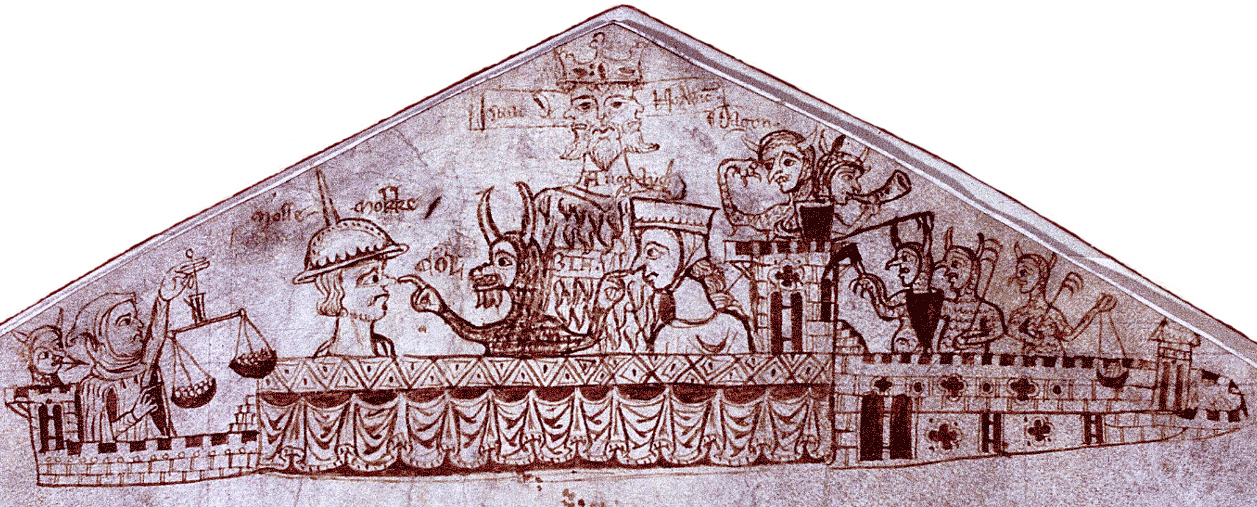
Share this image of a Medieval tax record with students. Tax records didn’t usually have pictures, but this one did. These records were documents that listed tax payments and this document records the payments made by Jewish people in the city of Norwich in Norfolk, England.
Lead the class in a short discussion about the image. Ask students what they see and what the various symbols might mean. This guide by the National Archives will help you to highlight certain aspects of the image. Help students to correctly interpret the image as anti-Jewish.
This lesson meets the following Academic Standards required by the Wisconsin Department of Public Instruction.
Before you teach, use our teacher primer to freshen up on your content knowledge.
This lesson summarizes the events leading up to, the event of, and the aftermath of Kristallnacht.
The Jewish people were abandoned by most of their fellow citizens and by those meant to protect them. Because of this Kristallnacht was a watershed moment which further ignited Hitler and the Nazi party’s intent to destroy the Jews.
Ask students what they might already know about Kristallnacht.
For the younger grades, or if the students are newly being introduced to Holocaust education, include some additional information. For example, tell students the name “Kristallnacht” is translated as “Night of Crystal” but is often referred to as the “Night of Broken Glass.” Some may know this name more than the official one. If they are not sure, have them guess what it could be based on the name.
Direct students to the resource, Kristallnacht by the US Holocaust Memorial Museum. Read through the document as a class. Start with the three key facts at the top of the page so students understand the main points as they go through the reading.
In a class discussion, go over the following questions:
Divide the class into groups of three to five and ask them to answer these questions about the reading. Ask students to take notes on their answers.
If time permits, come together as a class to go over the answers the groups came up with.
This lesson meets the following Academic Standards required by the Wisconsin Department of Public Instruction.
Before you teach, use our teacher primer to freshen up on your content knowledge.
Read a short text about the reality of life after the war in Displaced Person (DP) camps. Students will engage with the content by exploring a variety of questions about the post-war situation for Holocaust victims.
The process of rebuilding lives after the Holocaust was often long, painful, and arduous.
Lead a class discussion, asking students what they think of when they think of the word “home.” What does home mean to them?
Read the resource, Displaced Persons by Echoes & Reflections with the class, taking time to answer questions and clarify if necessary.
Take time to look at the statistics of Jewish DP’s in camps by 1946, pointing out that these were the majority of the survivors remaining in continental Europe from the population of about 10 million in 1933. Point out that many were forced to live in Displaced Person (DP) camps, often built within Nazi camp structures scattered across Europe.
Have students take 10-15 minutes to fill in their answers at the bottom of the resource they read by Echoes & Reflections. Once they finish, return as a class to go over their answers.
Lastly, return to the question of home. Has their idea of what home means changed from the start of the lesson?
This lesson meets the following Academic Standards required by the Wisconsin Department of Public Instruction.
Before you teach, use our teacher primer to freshen up on your content knowledge.
Explore images of liberation and life within Displaced Person (DP) camps. Students will read survivor testimony about their bittersweet experiences immediately following the war and Allied occupation of Europe.
Liberation after the Holocaust did not necessarily mean the end to people’s suffering and trauma.
Ask students what the words “liberation” and “freedom” mean to them. Usually people give positive answers to these concepts. Briefly explain that even though personal freedom and liberty is, objectively, good, in cases where you gain liberty and freedom after a period of trauma, fear, and violence, it can be a very difficult thing to adjust to and everyone reacts differently to it.
Give a brief presentation of images of life after liberation taken from the Yad Vashem archives. Point out the faces and body language of image subjects. Explain that people’s experiences of liberation were very different, as allied forces reclaimed territory at different times. Because there were so many people with nowhere to go and no possessions to speak of, often they would live in DP camps which were created from the remnants of the concentration camps that some were liberated from.
Divide the class into groups of 4 – 6 students.
Give each group a selection of survivor testimony provided by Yad Vashem to read and discuss. If possible, allow students to have access to, or have the presentation of images remain projected as they go through the testimonies. In these groups, the students will create a list of questions, concerns, and feelings that survivors bring up in the testimonies to present to the class.
As the groups present, collect their answers to be used in continued discussion. Were there common themes in survivor feelings, concerns, and questions of the future?
This lesson meets the following Academic Standards required by the Wisconsin Department of Public Instruction.
Before you teach, use our teacher primer to freshen up on your content knowledge.
Watch a video detailing the steps taken to isolate Jews from German life. Open up into a conversation about the precursors the world should be on the lookout for when seeing human rights violations taking place around the globe.
Isolation and dehumanization, when not countered, allows for increasingly harsh treatments and injustices to take place.
Ask students, what is segregation? Have them come up with some examples of ways in which people can be segregated from one another. Open the class into a brief conversation about segregation by asking the questions below.
Pull up the video, From Citizens to Outcasts, by the United States Holocaust Memorial Museum. Introduce the video by reading through the context that can be found directly above the Discussion Question. Provide students with the question below prior to starting the video. While they watch, have students take notes to answer it.
How did Nazi Germany gradually isolate, segregate, impoverish, and incarcerate Jews and persecute other perceived enemies of the state between 1933 and 1939?
Reiterate to students that Nazi Germany took great measurers in order to dehumanize the Jews. Propaganda made them out to be enemies of the state. These tactics made many non-Jewish Germans take little notice or regard for the mistreatment and grave injustice that would continue against the Jews.
Divide the class into groups of five. Provide the groups with the instructions below. Give students the opportunity and time to research if necessary.
This lesson meets the following Academic Standards required by the Wisconsin Department of Public Instruction.
Before you teach, use our teacher primer to freshen up on your content knowledge.
Watch video testimonies from Jewish survivors from USC iWitness. Students will open into a discussion about segregation in history and modern day.
As devastating a reality as we have seen from segregation in history, it still prevails in the world today.
Begin by asking the class to write a short response answering the questions below. Assure students they will not be asked to share what they have written.
You may also want to provide students with the official definition. Take this time to mention to students that segregation can be racial and religious.
Segregation: the enforced separation of different racial groups in a country, community, or establishment.
It is equally important to note that segregation can be further identified as being de jure or de facto. De jure segregation is implemented by laws while de facto segregation is based off common understanding and personal choice.
Watch video testimonies on Kurt Baum (clips 19-23; 19:00-23:00 minutes) and Nomick Cyanmon (clip 17; 4:32-6:45) on USC IWitness.
Show testimonies one at a time, stopping to answer the questions for one before moving on to the other.
Questions for Kurt Baum:
Questions for Nomick Cynamon:
In an open forum, ask students for examples of segregation in communities, both in times of the Holocaust and in modern times.
Give students some time to add to what they wrote down at the beginning of the class.
This lesson meets the following Academic Standards required by the Wisconsin Department of Public Instruction.
Before you teach, use our teacher primer to freshen up on your content knowledge.