Dachau Song
Experience the vitality and power of a song written and sung by prisoners in the Dachau Concentration Camp in southern Germany by inviting your students to critically evaluate its lyrics.
Patterns stay the same over a period of time
Students will go through resources on antisemitism in the early modern era as well as a resource on the Nazi book burning of 1933.
Antisemitism and oppression has plagued the Jewish people for centuries. In the early modern era, and continuing on into Nazi rule, the Jews were kept from working certain jobs and often looked at in a negative light.
Ask students what it means to be an oppressed group. Can you think of some groups throughout history that faced oppression?
Walk students through the resource, Antisemitism in History: The Early Modern Era, 1300-1800 by the United Stated Holocaust Memorial Museum.
Then ask your students, why do people generalize characteristics for an entire group? How can this be dangerous? Take a few minutes to discuss this as a class before moving on.
Next, pull up the resource, Book Burning by the USHMM Holocaust Encyclopedia and go over the Critical Thinking Questions at the bottom of the page.
In groups of five, ask students to consider the following question:
This lesson meets the following Academic Standards required by the Wisconsin Department of Public Instruction.
Before you teach, use our teacher primer to freshen up on your content knowledge.
Analyze an antisemitic document from 1903 to understand how the lie that Jews killed Jesus was used to incite violence against Jews.
Institutions such as religion can contribute to the spread of hatred and lies that can be used to justify violence against others. Hitler drew on this hatred and expanded it, but he did not invent it.
Ask students to define prejudice. Ask them about the sources of prejudice. Is prejudice always taught within families, or can institutions also teach prejudice? Although this reading focuses on religion, teachers should name a number of institutions in the general discussion, such as religion, schools, government, and medicine.
Explain the concept of the Blood Libel to students. The blood libel refers to the false allegation that Jews used the blood of non-Jewish, usually Christian children, for ritual purposes. You can provide a brief overview of blood libel using Holocaust Encyclopedia – Blood libel.
Explain that the document you are about to share is antisemitic and spreads lies about Jews. Pull up the primary resource, Proclamation Inciting a Jewish Pogrom (1903) and continue to the Output section.
The output for this lesson is done as a whole class, to avoid printing out an antisemitic text and having a student leave with it. As a class, highlight the lies about Jews in this document on the screen. Then ask students, How does the text justify violence against Jews? Using a different color, highlight the calls to violence in the document. Ask students what the date of the document (1903) shows us about the Holocaust.
This lesson meets the following Academic Standards required by the Wisconsin Department of Public Instruction.
Before you teach, use our teacher primer to freshen up on your content knowledge.
Students will read a short Anti-Defamation League article about antisemitism in the medieval period. They will then read, analyze, and present a short primary source detailing an act or written piece of antisemitism from the medieval period.
Anti-Jewish action and antisemitism was common in the Western world since the Classical era. As time passed, superstitions and suspicions about Jewish populations reinforced hatred and persecution that continues to affect Jewish populations today. The medieval period in particular saw violence toward, and persecution of, Jewish people – especially in Christian empires.
Ask students if they know what antisemitism is, and why it’s relevant today.
Read the sections of the article by the ADL on antisemitism throughout history titled “Islamic World” and “Medieval Christendom” as a class (a unit on antisemitism more broadly could use more of the article).
Lead a class discussion on the material. Ask students:
This lesson meets the following Academic Standards required by the Wisconsin Department of Public Instruction.
Before you teach, use our teacher primer to freshen up on your content knowledge.
Students will watch a video by Yad Vashem explaining the Nazi ideology of race hierarchy. This lesson will open your students up to a discussion on race and the role it plays in society.
Nazi ideology pushed the need for racial purity and claimed that disobeying this would bring the destruction of mankind.
Begin by asking your students if they have heard of Darwin’s Theory of Evolution. What does it state? What was the theory applied to?
Show students a YouTube video titled, Key Historical Concepts in Holocaust Education: Race Doctrine by Yad Vashem. Before starting the video, give students the list of questions. Let them know they will have a chance to watch the video a second time.
Give students a few minutes to finish writing down their answers. Watch the video a second time if needed and then go over the questions as a class.
Divide the class into groups of four. Provide them with this quote by American novelist and winner of the Nobel Prize in Literature, Toni Morrison, “There is no such thing as race. None. There is just a human race – scientifically, anthropologically.”
In their groups, ask students to have a discussion with the questions below:
Reconvene as a class to open up the discussion. Were there any disagreements within the groups?
This lesson meets the following Academic Standards required by the Wisconsin Department of Public Instruction.
Before you teach, use our teacher primer to freshen up on your content knowledge.
Students will learn about anti-Jewish attitudes that pre-dates the Holocaust by centuries.
Anti-Jewish sentiment was rife for centuries before the Holocaust, particularly in historically Christian countries and empires. Jewish life was under constant threat of violence, to the point that sometimes entire Jewish communities were massacred.
Explain that historically, anti-Jewish sentiment was a common phenomenon in the Western, Christian sphere for over a millennia. Jews were often limited in their livelihoods and where they were allowed to reside. The medieval period in particular – a time of religious crusades and conquest – was full of anti-Jewish rumours, sentiment, and action. Jews were thought to be responsible for the crucifixion, and the idea of Blood Libel (Jewish slaughter of Christian children for religious rituals) was born. At the same time, ill-treatment of Jews was not always met with sympathy. Similar to today, there were people who disapproved of the hatred and violence they faced.
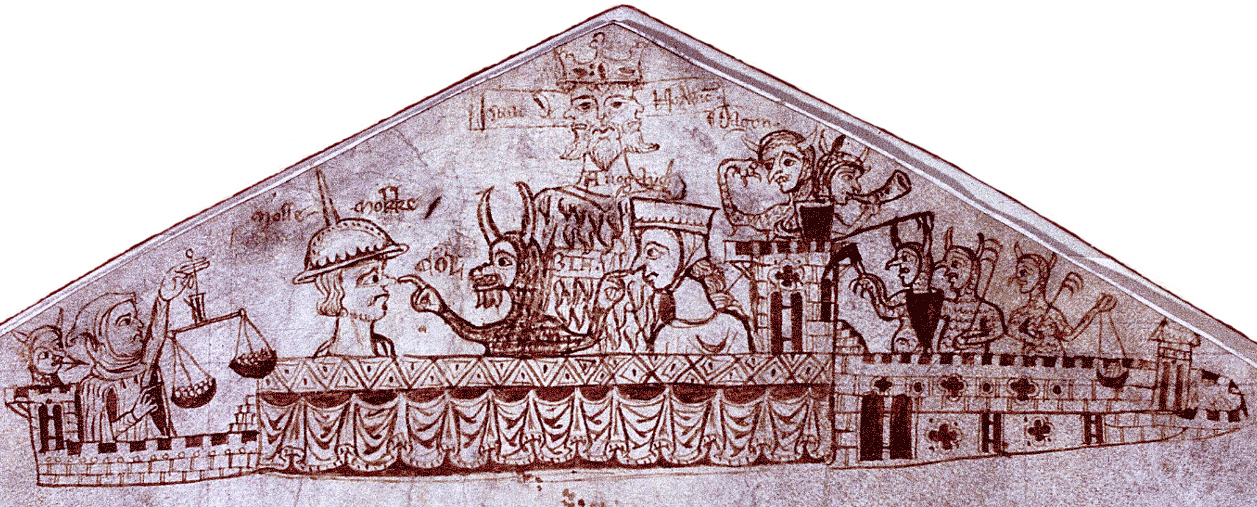
Share this image of a Medieval tax record with students. Tax records didn’t usually have pictures, but this one did. These records were documents that listed tax payments and this document records the payments made by Jewish people in the city of Norwich in Norfolk, England.
Lead the class in a short discussion about the image. Ask students what they see and what the various symbols might mean. This guide by the National Archives will help you to highlight certain aspects of the image. Help students to correctly interpret the image as anti-Jewish.
This lesson meets the following Academic Standards required by the Wisconsin Department of Public Instruction.
Before you teach, use our teacher primer to freshen up on your content knowledge.
Students will learn the history of antisemitism and how it was transformed into Nazi racial antisemitism through the years.
Antisemitism was not invented with the rise of the Nazi party. It had deep roots that were transformed to fit the racist ideology of the time.
Begin by prompting your students to think about forms of intolerance. What kind of ‘isms’ can they think of that separate one group from another in a detrimental way?
Do they believe that certain ‘isms’ are more powerful than others? Why might this be?
This lesson can be found in an expanded form here.
Divide students into groups or pairs.
Distribute the first definition card within this three page bundle, which defines the terms ideology, racists and ethnicity.
In groups, pairs, or individually students work to define the yellow highlighted words. After the group defines the word, they use dictionaries to check their definitions.
After 5 minutes come together and have students briefly share:
Pivot toward the question of pseudoscience: Now that we have definitions of racists and race, let’s examine the pseudo science behind beliefs that human behavior is biologically determined. See if they know what pseudo means.
Distribute and read definition cards two and three which defines pseudo, science and racial antisemitism.
–> Students can repeat the definitional activity used with the first definition cards for the second and third cards as well..
Check for understanding of the concept of pseudoscience and racial antisemitism.
Answer questions or clear misconceptions before proceeding.
Watch this short clip from USHMM about racism in the Nazi party. Then ask students to respond to the following questions either in writing or small groups before opening up for a large group discussion. You may also assign certain questions to groups or individuals to reduce the time for responses.
This lesson meets the following Academic Standards required by the Wisconsin Department of Public Instruction.
Before you teach, use our teacher primer to freshen up on your content knowledge.
Read through a translation of the famous text J’Accuse! and answer questions based off of the text. Students will learn about bias, perspective, and the construction of history.
Antisemitic racism was alive and well in Europe well before the Nazis came to power.
Provide students with a brief overview of the Dreyfus Affair. A presentation with important dates and facts can be found here. Go over this with your students if you feel it necessary and time permits.
In brief, explain to students that Alfred Dreyfus was accused of stealing military secrets with weak evidence and was sentenced to prison. Tell students that the document they will be reading is a newspaper article written by a Dreyfus supporter, Emile Zola, who accused the French military of a conspiracy against Dreyfus.
Read through the translation of J’Accuse! provided by the University of Pennsylvania Library as a class.
As you read together collectively, ask students to take notes utilizing the 3Ps Method; taking note of things they find a) Powerful b) Puzzling and c) Propelling.
Once you’ve finished reading, attempt to clarify the sections that students found puzzling.
In order to familiarize yourself, and your class with this model, please look over this guide: 3Ps: A Critical Reading Guide.
Divide students into pairs or groups of three before directing them to the Reading Road Map questions at the bottom of the reading. Give students approximately 10-15 minutes to jot down their answers.
After everyone has had a chance to write down their answers, go over the questions as a class. Finally, address the essential questions directly to the class and open up a class discussion on whether biases still exist in justice systems today.
This lesson meets the following Academic Standards required by the Wisconsin Department of Public Instruction.
Before you teach, use our teacher primer to freshen up on your content knowledge.
Students will learn the history of anti-Judaism and its relevance when studying the Holocaust. Open up into a discussion about prejudices in history and how rumors and hatred get carried through generations.
Stereotypes and misinformation of the Jewish people has persisted and changed through the years, with much of it still visible in present day.
Ask students how they define religion. Then, how might they define ‘religious differences’?
Furthermore, can they consider how religious differences have been handled throughout history? Is this a peaceful history or a bloody one?
Divide the class into a maximum of six groups. Have each group elect one person as their recorder. Note that everyone else must read and all members should contribute to the answers.
Direct student to the resource, Anti-Judaism before the Enlightenment by Facing History and Ourselves. Ask students to read through the resource and go over the Connection Questions found at the bottom of the page in their small group. Have groups write down their answers. Give 25 minutes for this exercise.
Come back together as a class and go over the answers to the connection questions. Ask each group to answer one question, selecting them randomly. Tell students they should be adding to their answers with thoughts discussed by the class and answers from other groups.
If time permits, ask students the questions below in an open discussion.
This lesson meets the following Academic Standards required by the Wisconsin Department of Public Instruction.
Before you teach, use our teacher primer to freshen up on your content knowledge.
Explore a summary of contemporary antisemitism, spanning the history between World War II and today.
Antisemitism is an ongoing issue throughout the world.
Ask your students if they have heard the term antisemitism before. If they have, how do they understand it? Guide discussion toward the definition from the Anti-Defamation League to set the stage for the rest of the lesson.
Turn toward the reading about Contemporary Antisemitism from Echoes & Reflections. Begin by reading the first section aloud as a class, answering any questions or defining words about which the students require clarification.
Then, divide the class into two groups.
Have every student read their section individually. Then pair with another member of their group to clarify the main points, questions, and challenges.
Finally, ask group 1 pairs to partner with group 2 pairs.
Have each pair share their summary of the section they read. What were the most important parts, what questions do they have, what is their understanding of the historical era being addressed?
Then, ask the quartet to answer the following set of questions:
This lesson meets the following Academic Standards required by the Wisconsin Department of Public Instruction.
Before you teach, use our teacher primer to freshen up on your content knowledge.
Watch a compelling video about antisemitism as it manifests in the world today, with insights from global experts on the subject.
Antisemitism undermines the foundations of democracy.
At the opening of the video, Samatha Power says, “it would be a grave mistake to view antisemitism as something that merely affects the Jewish people.” Provide this short quote to your students before viewing the video and prompt them to pre-write about it. What do they think it means? How can this be so? Give them 5 minutes to compose some thoughts and then ask them to share.
Watch Antisemitism Today by the USHMM. The video is complex and might be broken down for clarity by pausing between the following sections.
At the conclusion of each section, ask students to reflect on what they understood, what confused them, and what questions they have about the subject. Give space to address these insights.
Beginning to 1:35: What is antisemitism and why it is a problem for democracy
1:35 – 3:00: Two non-governmental manifestations, Islamic & Right Wing extremism
3:00 – 4:35: Antisemitism and its relationship to anti-Zionism and Holocaust denial
4:35 – End: The threat to society created by antisemitism
After the discussion of the video is over and students are feeling comfortable with the information, return to the quote highlighted by Samatha Powers:
“It would be a grave mistake to view antisemitism as something that merely affects the Jewish people.”
Ask your students to expand on their initial writing by answering the following questions:
Give students 10 minutes to reflect on these questions.
If time permits, have students share their reflections in small groups or full class discussion.
This lesson meets the following Academic Standards required by the Wisconsin Department of Public Instruction.
Before you teach, use our teacher primer to freshen up on your content knowledge.