The Kielce Pogrom
Students will read about the Kielce Pogrom and watch videos on testimonies and the aftermath. This lesson takes your class into a discussion about oppression against Jews and other groups.
Students will learn about cultural/spiritual resistance in the ghettos from video testimonies.
Resistance for many Jews was extremely difficult. With the effort it took to survive, many did not have the strength. However, many still found ways of resisting- both with armed/active resistance and with cultural/spiritual resistance.
This lesson is adapted from Jewish Resistance by Echoes & Reflections. The full unit can be found here.
Have students think about the term “resistance” in the context of the Holocaust. Have them consider and respond to the question, “What are Jews resisting during the Holocaust?”
Explain to your students that despite the risk of harsh and fatal punishments, many Jews still chose to resist in any way they could. Ask students for possible reasons for why some Jews could not resist. (Hunger, sickness, isolation, lack of weapons, care for children, parents, or other family members). Record their answers on the board.
In addition to the term “resistance,” have students think of the term “survival.” Take a few minutes to discuss how these terms are similar and how they are different. Share the official definitions of resistance and survival with the class.
Resistance: the refusal to accept or comply with something: the attempt to prevent something by action or argument.
Survival: the state of continuing to live or exist, typically in spite of an accident, ordeal, or difficult circumstances.
Write down the heading, “Jewish Resistance during the Holocaust” and below write the subheadings “Cultural/Spiritual Resistance” and “Active/Armed Resistance.” Ask a student volunteer to write down key ideas for each form of resistance under the appropriate heading.
Explain that spiritual resistance can often be seen as an attempt to maintain one’s previous way of life and his or her unique identity. The terrible reality in which Jews lived was expressed by the teacher, Chaim Kaplan who lived in the Warsaw ghetto: “Everything is forbidden to us, but we do everything.”
Play the video testimonies for Roman Kent and Helen Fagin to the class. There will be a few questions specific to each testimony, so you may choose to play one at a time and have the students answer the questions corresponding to the video before moving on to the second one. Ask the questions in an open discussion with the class.
Questions on Roman Kent:
Questions on Helen Fagin:
Have the students take 10 minutes to reflect and write out how their understanding of resistance has changed over the course of the lesson.
Take the time you have left to ask students to share what they wrote down in response to the prompt.
This lesson meets the following Academic Standards required by the Wisconsin Department of Public Instruction.
Before you teach, use our teacher primer to freshen up on your content knowledge.
Students will create and build upon a working definition of resistance. To do so, students will read a poem on resistance and a call to action written by Abba Kovner.
Resistance came in all forms. Stealing food, hiding, fighting, and spreading information were all ways in which people resisted the Nazis.
Start by defining resistance for the class: “The refusal to accept or comply with something; the attempt to prevent something by action or argument.”
Next, ask students to work in groups of three to create a working definition for resistance. A working definition is one that builds in meaning as they receive information and gain clarity on the topic.
In these same groups, have students read through the poem “Resistance Is…” from Facing History and Ourselves. Ask the class if they would want to alter or add to their definitions of resistance after reading it. Give them a few minutes (no more than 5) to add to their working definitions.
Divide the class into groups of three to read through the Pronouncement by Abba Kovner from Echoes & Reflections. Let students know that Abba Kovner wrote this manifesto while at the Vilna ghetto in an attempt to stage an uprising.
Have one student from each group read through the text out loud as the others follow in silence. Then have each group discuss the questions below. Have one student in each group take notes that include the significant points of their discussion.
Ask the groups to read through the passage once more. This time, having them focus on the language and answer the following questions:
Have each group review the first definition of resistance that they wrote at the beginning of the lesson. Still in their groups, encourage them to discuss whether or not they think they need to make more changes after analyzing Abba Kovner’s call to resistance. Give them a few minutes to do so.
Ask each group to share their definition of resistance and explain what revisions they made and why.
This lesson meets the following Academic Standards required by the Wisconsin Department of Public Instruction.
Before you teach, use our teacher primer to freshen up on your content knowledge.
Analyze an antisemitic document from 1903 to understand how the lie that Jews killed Jesus was used to incite violence against Jews.
Institutions such as religion can contribute to the spread of hatred and lies that can be used to justify violence against others. Hitler drew on this hatred and expanded it, but he did not invent it.
Ask students to define prejudice. Ask them about the sources of prejudice. Is prejudice always taught within families, or can institutions also teach prejudice? Although this reading focuses on religion, teachers should name a number of institutions in the general discussion, such as religion, schools, government, and medicine.
Explain the concept of the Blood Libel to students. The blood libel refers to the false allegation that Jews used the blood of non-Jewish, usually Christian children, for ritual purposes. You can provide a brief overview of blood libel using Holocaust Encyclopedia – Blood libel.
Explain that the document you are about to share is antisemitic and spreads lies about Jews. Pull up the primary resource, Proclamation Inciting a Jewish Pogrom (1903) and continue to the Output section.
The output for this lesson is done as a whole class, to avoid printing out an antisemitic text and having a student leave with it. As a class, highlight the lies about Jews in this document on the screen. Then ask students, How does the text justify violence against Jews? Using a different color, highlight the calls to violence in the document. Ask students what the date of the document (1903) shows us about the Holocaust.
This lesson meets the following Academic Standards required by the Wisconsin Department of Public Instruction.
Before you teach, use our teacher primer to freshen up on your content knowledge.
Compare and contrast a map from before World War I to a map after World War I. Students analyze the significance of the changes in the map, looking particularly at the countries that comprised the Axis powers and the Allied powers.
The changes brought about by World War I influenced people and governments years later, shaping the decisions that led to World War II and the Holocaust.
Explain that maps are one way to analyze the impact of World War I. Tell students that you are going to look at changes in empires and ask if they know what an empire is. If they don’t, provide a brief definition. Remind students that in World War I, the Axis powers were led by Germany, Austria-Hungary, and the Ottoman Empire (which became Turkey after the war), and the Allied powers were led by Great Britain, France, Italy, Russia (until 1917) and the United States (beginning in 1917).
Access the Empires before World War I map from 1914 and the The World after World War I map from 1920 from Facing History and Ourselves. Display them side by side for students. Ask students to look closely at the maps, noticing differences between the two maps. Students can begin by looking at the colors, and seeing which have increased and which have decreased. Students can then identify which empires and countries expanded their territory between 1914 and 1920, and which lost territory. Ask students to notice which countries existed in 1914 but not in 1920, and which countries are on the map in 1920 but not in 1914.
Divide the class into groups of 3 – 5 students
Assign an empire or country from the 1914 map to each group. Have each group write down answers to the following questions using information from the maps.
As the groups reflect, highlight their answers to the final question. These can be used as touchpoints in thinking about the precursors of the Holocaust.
This lesson meets the following Academic Standards required by the Wisconsin Department of Public Instruction.
Before you teach, use our teacher primer to freshen up on your content knowledge.
Students will read a short Anti-Defamation League article about antisemitism in the medieval period. They will then read, analyze, and present a short primary source detailing an act or written piece of antisemitism from the medieval period.
Anti-Jewish action and antisemitism was common in the Western world since the Classical era. As time passed, superstitions and suspicions about Jewish populations reinforced hatred and persecution that continues to affect Jewish populations today. The medieval period in particular saw violence toward, and persecution of, Jewish people – especially in Christian empires.
Ask students if they know what antisemitism is, and why it’s relevant today.
Read the sections of the article by the ADL on antisemitism throughout history titled “Islamic World” and “Medieval Christendom” as a class (a unit on antisemitism more broadly could use more of the article).
Lead a class discussion on the material. Ask students:
This lesson meets the following Academic Standards required by the Wisconsin Department of Public Instruction.
Before you teach, use our teacher primer to freshen up on your content knowledge.
Explore the creation of the Nuremberg Race Laws and what the significance of their implementation into society meant for the future of Jews in Germany.
The Nuremberg Race Laws aimed to define race and provide the framework for the systematic persecution of Jews in Germany.
Explain to students that the Nuremberg Laws were the first official step in systematic persecution of Jews in Germany. Creating this definition was not an easy task, it took years for German officials to agree on what being Jewish meant. This initial step in identifying and separating Jews from society was essential to carry out the persecution that followed.
Take the students through the resource, Nuremberg Race Laws by the US Holocaust Memorial Museum. With a partner, ask the students to go through the resource and take notes using the 3Ps method, jotting down what they find a) Profound b) Puzzling and c) Propelling.
In order to familiarize yourself, and your class with this model, please look over this guide: 3Ps: A Critical Reading Guide.
Have the pairs partner up with another group to form groups of four. As they gather in these groups, provide them with the following instructions:
Give students 20 minutes to complete these tasks and use the last 10 minutes to hear what the groups came up with for their questions.
This lesson meets the following Academic Standards required by the Wisconsin Department of Public Instruction.
Before you teach, use our teacher primer to freshen up on your content knowledge.
Students will watch a short film about the idea of Blood Libel. To accompany this video, students will read short stories about how Blood Libel was used to blame Jews for incidents in the community.
Blood libel grew out of an ancient accusation and has been carried by antisemitic ideology for centuries.
Lead a short 5-minute discussion about antisemitic ideas commonly found today. Examples of topics include the ideas that Jews killed Jesus, Jews control money and the media, Jews have split-loyalty to Israel, and blood libel.
Watch the short film about blood libel by Facing History and Ourselves.
In small groups of 3-5, have students read the four contemporary short stories of blood libel. Ask the groups to take notes on similarities in each story.
Lead a class discussion on blood libel. Ask the students what similarities and differences they found within the stories they read, and what they thought reactions by local Christians were to accusations of blood libel. In particular, make sure to point out the fact that most of these stories are recorded by poets and folklorists – not necessarily told as first-hand accounts. Ask students why they think people believe in blood libel, and how dangerous and powerful a lie can be as it persists over time.
Before you teach, use our teacher primer to freshen up on your content knowledge.
Students will learn about anti-Jewish attitudes that pre-dates the Holocaust by centuries.
Anti-Jewish sentiment was rife for centuries before the Holocaust, particularly in historically Christian countries and empires. Jewish life was under constant threat of violence, to the point that sometimes entire Jewish communities were massacred.
Explain that historically, anti-Jewish sentiment was a common phenomenon in the Western, Christian sphere for over a millennia. Jews were often limited in their livelihoods and where they were allowed to reside. The medieval period in particular – a time of religious crusades and conquest – was full of anti-Jewish rumours, sentiment, and action. Jews were thought to be responsible for the crucifixion, and the idea of Blood Libel (Jewish slaughter of Christian children for religious rituals) was born. At the same time, ill-treatment of Jews was not always met with sympathy. Similar to today, there were people who disapproved of the hatred and violence they faced.
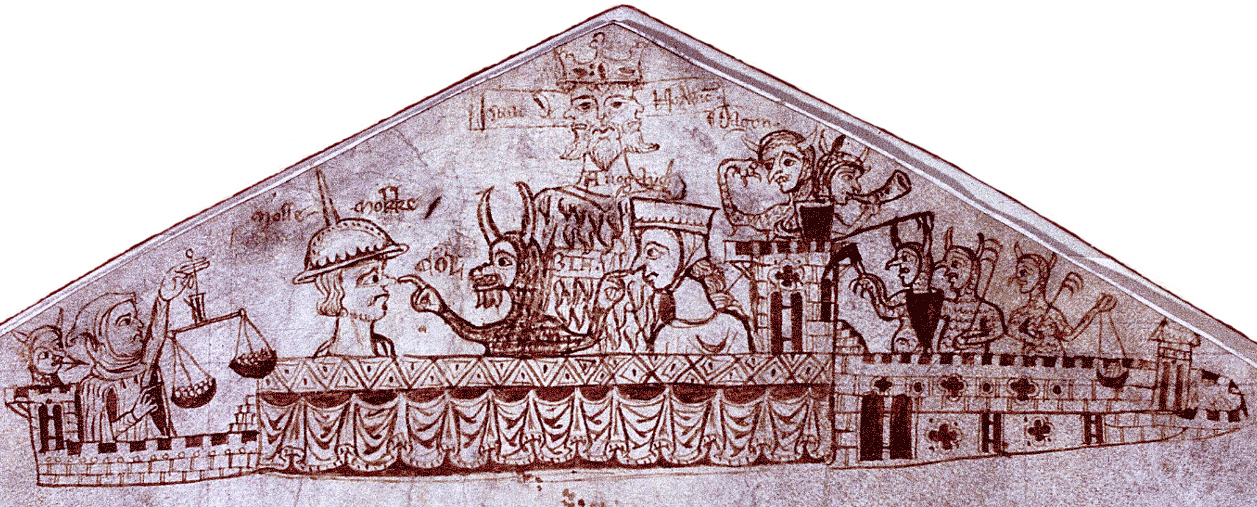
Share this image of a Medieval tax record with students. Tax records didn’t usually have pictures, but this one did. These records were documents that listed tax payments and this document records the payments made by Jewish people in the city of Norwich in Norfolk, England.
Lead the class in a short discussion about the image. Ask students what they see and what the various symbols might mean. This guide by the National Archives will help you to highlight certain aspects of the image. Help students to correctly interpret the image as anti-Jewish.
This lesson meets the following Academic Standards required by the Wisconsin Department of Public Instruction.
Before you teach, use our teacher primer to freshen up on your content knowledge.
This lesson will help students understand the events of Kristallnacht and the different views and perspectives of those who witnessed it. This lesson will allow them to gain a deeper understanding of the varying human reactions to this violent pogrom against the Jews.
Those who witness injustice, without participation in the action, have the ability and the power to shape the consequences of those injustices through their response.
Ask students, “What happened on November 10, 1938?”
Show students the video, Kristallnacht: The November 1938 Pogroms by Facing History and Ourselves.
Divide the class into groups of three to five and assign a reading to each group.
Group 1: The Night of the Pogrom
Group 2: Opportunism during Kristallnacht
Group 3: A Family Responds to Kristallnacht
Group 4: Thoroughly Reprehensible Behavior
Group 5: A Visitor’s Perspective on Kristallnacht
Group 6: World Responses to Kristallnacht
Ask students to complete these steps after they read their group assigned reading as outlined in the Facing History lesson:
Once completed, pose the question again, “What happened on November 10th, 1938?” What can they now add to this question? Where did they get this information?
This lesson meets the following Academic Standards required by the Wisconsin Department of Public Instruction.
Before you teach, use our teacher primer to freshen up on your content knowledge.
Explore images of liberation and life within Displaced Person (DP) camps. Students will read survivor testimony about their bittersweet experiences immediately following the war and Allied occupation of Europe.
Liberation after the Holocaust did not necessarily mean the end to people’s suffering and trauma.
Ask students what the words “liberation” and “freedom” mean to them. Usually people give positive answers to these concepts. Briefly explain that even though personal freedom and liberty is, objectively, good, in cases where you gain liberty and freedom after a period of trauma, fear, and violence, it can be a very difficult thing to adjust to and everyone reacts differently to it.
Give a brief presentation of images of life after liberation taken from the Yad Vashem archives. Point out the faces and body language of image subjects. Explain that people’s experiences of liberation were very different, as allied forces reclaimed territory at different times. Because there were so many people with nowhere to go and no possessions to speak of, often they would live in DP camps which were created from the remnants of the concentration camps that some were liberated from.
Divide the class into groups of 4 – 6 students.
Give each group a selection of survivor testimony provided by Yad Vashem to read and discuss. If possible, allow students to have access to, or have the presentation of images remain projected as they go through the testimonies. In these groups, the students will create a list of questions, concerns, and feelings that survivors bring up in the testimonies to present to the class.
As the groups present, collect their answers to be used in continued discussion. Were there common themes in survivor feelings, concerns, and questions of the future?
This lesson meets the following Academic Standards required by the Wisconsin Department of Public Instruction.
Before you teach, use our teacher primer to freshen up on your content knowledge.