The Power of a Lie
Students will watch a short film about the idea of Blood Libel. To accompany this video, students will read short stories about how Blood Libel was used to blame Jews for incidents in the community.
Students will watch a short film showing a pro-Nazi demonstration from 1939 in New York.
American citizens were aware of Nazi ideology and some supported and embraced these values.
Explain to your students that while the Nazi party only resided in Germany, Nazi ideology and practices sprouted in areas within the United States. The German-American Bund was a pro-Nazi organization for Americans of German descent. The Bund’s leader, Fritz Kuhn, tried to portray himself as the “American fuhrer,” although the organization never received support from the Nazi party.
Explain to your students that the German-American Bund was present in multiple states. The largest Bund rally was held in 1939 at Madison Square Garden in New York.
Play this 7-minute film, A Night at the Garden by filmmaker Marshall Curry. Warn students that the video contains hateful speech and that some of the clip may be difficult to watch.
While they watch, ask students to take notes on what they see. When the film is over, take 5 minutes for students to share what they wrote down.
Use the remaining time to open a discussion with the questions below:
This lesson meets the following Academic Standards required by the Wisconsin Department of Public Instruction.
Before you teach, use our teacher primer to freshen up on your content knowledge.
Students will learn about the laws enacted in 1933 restricting the number of Jewish students in German public schools.
Laws limiting the number of Jewish students in schools and universities helped to segregate Jews and allowed for antisemitic ideas to be spread in classrooms.
Explain to students that a string of anti-Jewish legislation came into effect in Germany in 1933. These laws segregated Jews from Germans and restricted where they could work, who they could marry, and where they could attend school.
Direct students to the resource, Law Limits Jews in Public Schools by the US Holocaust Memorial Museum.
Discuss the following questions in an open discussion:
This lesson meets the following Academic Standards required by the Wisconsin Department of Public Instruction.
Before you teach, use our teacher primer to freshen up on your content knowledge.
Students will compare the original German soldiers’ oath to the one created by Hitler.
Dictatorial leaders consolidate power by requiring absolute loyalty to them.
Ask the class, What is an oath? What purpose does it mean to take an oath?
Direct students to the resource, ‘Pledging Allegiance’ by Facing History and Ourselves. Divide the class into groups of 3-5 and have them read through the resource as a group.
In their groups of 3-5, have students discuss the Connection Questions at the bottom of the resource page.
This lesson meets the following Academic Standards required by the Wisconsin Department of Public Instruction.
Before you teach, use our teacher primer to freshen up on your content knowledge.
Students will learn about the War Guilt Clause added to the Treaty of Versailles.
As part of the Treaty of Versailles, Germany was forced to sign the War Guilt Clause, taking full responsibility for starting World War I. Germans bitterly resented this addition to the treaty.
Explain to students that World War I was known to be the most destructive war the world had seen. It ended with the signing of the Treaty of Versailles in June 1918.
Share this image by Facing History and Ourselves with your students. What can you gather from this picture?
Direct students to the resource ‘Treaty of Versailles: The War Guilt Clause’ by Facing History and Ourselves.
Explain to the class that in addition to taking full responsibility for the war, Germany would have to pay heavy reparations, had considerable territory losses, and was required to dramatically reduce their military.
As a class, discuss the following questions:
This lesson meets the following Academic Standards required by the Wisconsin Department of Public Instruction.
Before you teach, use our teacher primer to freshen up on your content knowledge.
A brief case study highlights how individual decisions strengthen Nazism.
The Holocaust was not inevitable but was the result of the choices made by many individuals.
Ask students what it means to be a perpetrator, to perpetuate a crime. Ask them who the perpetrators of the Holocaust were. Explain that today you are focusing on how seemingly small decisions contributed to the perpetration of the Holocaust, even if that was not the person’s intent.
Listen to the audio file, “Do You Take the Oath?” by Facing History and Ourselves.
Think-Pair-Share.
Think: Have students spend a few minutes writing down their response to this question: Why did the man in the recording sign the oath? (3 minutes)
Pair: Have students talk to the person next to them about their answers. Do they think the man should have made a different choice? Why was it hard to make a different choice?
Share: Use this exercise to engage in a discussion about Holocaust perpetrators. Was the man a perpetrator? How does he seem different from the Nazis seen in the movies? In the final wrap up to the lesson, the teacher should highlight that the Holocaust required the consent and participation of many different people, including business people, doctors, nurses, architects, pastors, teachers, store owners, and laborers. Some of these people participated because they agreed with Nazism but other people acted with self-interest and ended up strengthening Nazism.
This lesson meets the following Academic Standards required by the Wisconsin Department of Public Instruction.
Before you teach, use our teacher primer to freshen up on your content knowledge.
Analyze an antisemitic document from 1903 to understand how the lie that Jews killed Jesus was used to incite violence against Jews.
Institutions such as religion can contribute to the spread of hatred and lies that can be used to justify violence against others. Hitler drew on this hatred and expanded it, but he did not invent it.
Ask students to define prejudice. Ask them about the sources of prejudice. Is prejudice always taught within families, or can institutions also teach prejudice? Although this reading focuses on religion, teachers should name a number of institutions in the general discussion, such as religion, schools, government, and medicine.
Explain the concept of the Blood Libel to students. The blood libel refers to the false allegation that Jews used the blood of non-Jewish, usually Christian children, for ritual purposes. You can provide a brief overview of blood libel using Holocaust Encyclopedia – Blood libel.
Explain that the document you are about to share is antisemitic and spreads lies about Jews. Pull up the primary resource, Proclamation Inciting a Jewish Pogrom (1903) and continue to the Output section.
The output for this lesson is done as a whole class, to avoid printing out an antisemitic text and having a student leave with it. As a class, highlight the lies about Jews in this document on the screen. Then ask students, How does the text justify violence against Jews? Using a different color, highlight the calls to violence in the document. Ask students what the date of the document (1903) shows us about the Holocaust.
This lesson meets the following Academic Standards required by the Wisconsin Department of Public Instruction.
Before you teach, use our teacher primer to freshen up on your content knowledge.
Compare and contrast a map from before World War I to a map after World War I. Students analyze the significance of the changes in the map, looking particularly at the countries that comprised the Axis powers and the Allied powers.
The changes brought about by World War I influenced people and governments years later, shaping the decisions that led to World War II and the Holocaust.
Explain that maps are one way to analyze the impact of World War I. Tell students that you are going to look at changes in empires and ask if they know what an empire is. If they don’t, provide a brief definition. Remind students that in World War I, the Axis powers were led by Germany, Austria-Hungary, and the Ottoman Empire (which became Turkey after the war), and the Allied powers were led by Great Britain, France, Italy, Russia (until 1917) and the United States (beginning in 1917).
Access the Empires before World War I map from 1914 and the The World after World War I map from 1920 from Facing History and Ourselves. Display them side by side for students. Ask students to look closely at the maps, noticing differences between the two maps. Students can begin by looking at the colors, and seeing which have increased and which have decreased. Students can then identify which empires and countries expanded their territory between 1914 and 1920, and which lost territory. Ask students to notice which countries existed in 1914 but not in 1920, and which countries are on the map in 1920 but not in 1914.
Divide the class into groups of 3 – 5 students
Assign an empire or country from the 1914 map to each group. Have each group write down answers to the following questions using information from the maps.
As the groups reflect, highlight their answers to the final question. These can be used as touchpoints in thinking about the precursors of the Holocaust.
This lesson meets the following Academic Standards required by the Wisconsin Department of Public Instruction.
Before you teach, use our teacher primer to freshen up on your content knowledge.
Students will read a short Anti-Defamation League article about antisemitism in the medieval period. They will then read, analyze, and present a short primary source detailing an act or written piece of antisemitism from the medieval period.
Anti-Jewish action and antisemitism was common in the Western world since the Classical era. As time passed, superstitions and suspicions about Jewish populations reinforced hatred and persecution that continues to affect Jewish populations today. The medieval period in particular saw violence toward, and persecution of, Jewish people – especially in Christian empires.
Ask students if they know what antisemitism is, and why it’s relevant today.
Read the sections of the article by the ADL on antisemitism throughout history titled “Islamic World” and “Medieval Christendom” as a class (a unit on antisemitism more broadly could use more of the article).
Lead a class discussion on the material. Ask students:
This lesson meets the following Academic Standards required by the Wisconsin Department of Public Instruction.
Before you teach, use our teacher primer to freshen up on your content knowledge.
Students will learn about anti-Jewish attitudes that pre-dates the Holocaust by centuries.
Anti-Jewish sentiment was rife for centuries before the Holocaust, particularly in historically Christian countries and empires. Jewish life was under constant threat of violence, to the point that sometimes entire Jewish communities were massacred.
Explain that historically, anti-Jewish sentiment was a common phenomenon in the Western, Christian sphere for over a millennia. Jews were often limited in their livelihoods and where they were allowed to reside. The medieval period in particular – a time of religious crusades and conquest – was full of anti-Jewish rumours, sentiment, and action. Jews were thought to be responsible for the crucifixion, and the idea of Blood Libel (Jewish slaughter of Christian children for religious rituals) was born. At the same time, ill-treatment of Jews was not always met with sympathy. Similar to today, there were people who disapproved of the hatred and violence they faced.
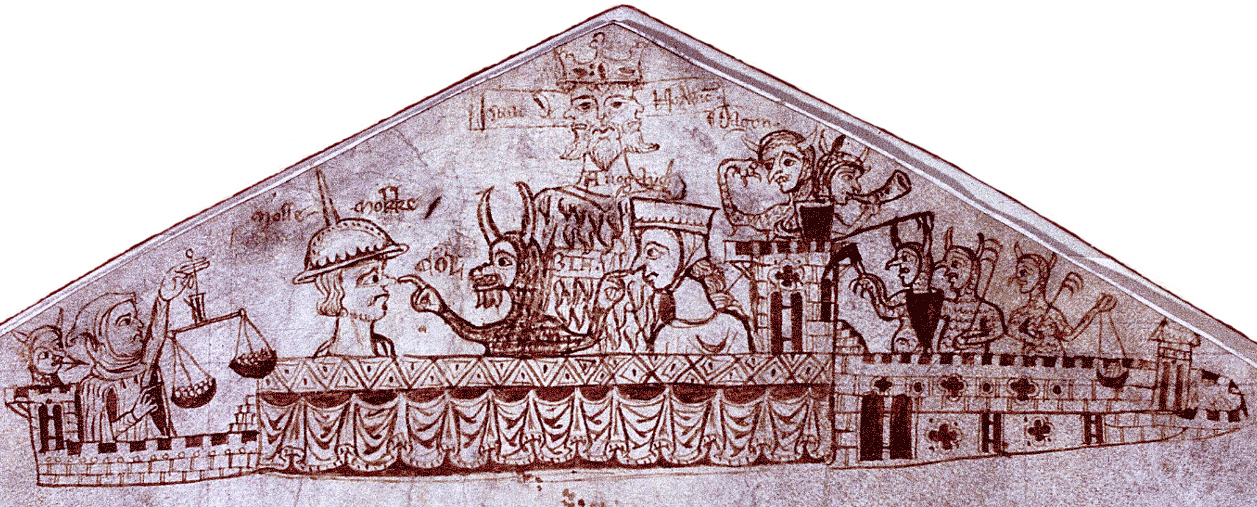
Share this image of a Medieval tax record with students. Tax records didn’t usually have pictures, but this one did. These records were documents that listed tax payments and this document records the payments made by Jewish people in the city of Norwich in Norfolk, England.
Lead the class in a short discussion about the image. Ask students what they see and what the various symbols might mean. This guide by the National Archives will help you to highlight certain aspects of the image. Help students to correctly interpret the image as anti-Jewish.
This lesson meets the following Academic Standards required by the Wisconsin Department of Public Instruction.
Before you teach, use our teacher primer to freshen up on your content knowledge.