History of Hatred
Students will learn the history of anti-Judaism and its relevance when studying the Holocaust. Open up into a discussion about prejudices in history and how rumors and hatred get carried through generations.
Compare and contrast a map from before World War I to a map after World War I. Students analyze the significance of the changes in the map, looking particularly at the countries that comprised the Axis powers and the Allied powers.
The changes brought about by World War I influenced people and governments years later, shaping the decisions that led to World War II and the Holocaust.
Explain that maps are one way to analyze the impact of World War I. Tell students that you are going to look at changes in empires and ask if they know what an empire is. If they don’t, provide a brief definition. Remind students that in World War I, the Axis powers were led by Germany, Austria-Hungary, and the Ottoman Empire (which became Turkey after the war), and the Allied powers were led by Great Britain, France, Italy, Russia (until 1917) and the United States (beginning in 1917).
Access the Empires before World War I map from 1914 and the The World after World War I map from 1920 from Facing History and Ourselves. Display them side by side for students. Ask students to look closely at the maps, noticing differences between the two maps. Students can begin by looking at the colors, and seeing which have increased and which have decreased. Students can then identify which empires and countries expanded their territory between 1914 and 1920, and which lost territory. Ask students to notice which countries existed in 1914 but not in 1920, and which countries are on the map in 1920 but not in 1914.
Divide the class into groups of 3 – 5 students
Assign an empire or country from the 1914 map to each group. Have each group write down answers to the following questions using information from the maps.
As the groups reflect, highlight their answers to the final question. These can be used as touchpoints in thinking about the precursors of the Holocaust.
This lesson meets the following Academic Standards required by the Wisconsin Department of Public Instruction.
Before you teach, use our teacher primer to freshen up on your content knowledge.
Explore the rise of Nazism in the early stages and see the road that allowed Adolf Hitler to climb the political ladder in Germany.
The rise of Nazism was aided by a depression that plagued Germany after the stock market crash of 1929, which left German citizens vulnerable to the rhetoric of a leader who promised to improve their lives.
Explain to students that Nazism became increasingly popular during the Great Depression and during a time of political crisis in Germany’s Weimar Republic. Ask your students to think critically about why they think this could be the case. What was it about the struggles of German life during this time that made the extremist views of the Nazis more appealing?
Print out the article by Facing History and Ourselves titled, Hitler in Power. Break people into small groups and have them read the page, underlining and making notes for each paragraph before moving on. After reading through, have students discuss the Connection Questions found at the bottom of the page.
After they go through the first resource, give them the resource, “Restoring” Germany’s Civil Service by Facing History and Ourselves. Let them do the same thing with this reading in their small groups. Have students go through the Connection Questions at the bottom of this page as well.
Devote approximately 15 minutes to each reading.
In an open discussion, ask students what they learned from going through the readings. What surprised them about the relationship between Adolf Hitler and President Paul von Hindenburg?
This lesson meets the following Academic Standards required by the Wisconsin Department of Public Instruction.
Before you teach, use our teacher primer to freshen up on your content knowledge.
Students will read a short Anti-Defamation League article about antisemitism in the medieval period. They will then read, analyze, and present a short primary source detailing an act or written piece of antisemitism from the medieval period.
Anti-Jewish action and antisemitism was common in the Western world since the Classical era. As time passed, superstitions and suspicions about Jewish populations reinforced hatred and persecution that continues to affect Jewish populations today. The medieval period in particular saw violence toward, and persecution of, Jewish people – especially in Christian empires.
Ask students if they know what antisemitism is, and why it’s relevant today.
Read the sections of the article by the ADL on antisemitism throughout history titled “Islamic World” and “Medieval Christendom” as a class (a unit on antisemitism more broadly could use more of the article).
Lead a class discussion on the material. Ask students:
This lesson meets the following Academic Standards required by the Wisconsin Department of Public Instruction.
Before you teach, use our teacher primer to freshen up on your content knowledge.
Explore the creation of the Nuremberg Race Laws and what the significance of their implementation into society meant for the future of Jews in Germany.
The Nuremberg Race Laws aimed to define race and provide the framework for the systematic persecution of Jews in Germany.
Explain to students that the Nuremberg Laws were the first official step in systematic persecution of Jews in Germany. Creating this definition was not an easy task, it took years for German officials to agree on what being Jewish meant. This initial step in identifying and separating Jews from society was essential to carry out the persecution that followed.
Take the students through the resource, Nuremberg Race Laws by the US Holocaust Memorial Museum. With a partner, ask the students to go through the resource and take notes using the 3Ps method, jotting down what they find a) Profound b) Puzzling and c) Propelling.
In order to familiarize yourself, and your class with this model, please look over this guide: 3Ps: A Critical Reading Guide.
Have the pairs partner up with another group to form groups of four. As they gather in these groups, provide them with the following instructions:
Give students 20 minutes to complete these tasks and use the last 10 minutes to hear what the groups came up with for their questions.
This lesson meets the following Academic Standards required by the Wisconsin Department of Public Instruction.
Before you teach, use our teacher primer to freshen up on your content knowledge.
Students will watch a video by Yad Vashem explaining the Nazi ideology of race hierarchy. This lesson will open your students up to a discussion on race and the role it plays in society.
Nazi ideology pushed the need for racial purity and claimed that disobeying this would bring the destruction of mankind.
Begin by asking your students if they have heard of Darwin’s Theory of Evolution. What does it state? What was the theory applied to?
Show students a YouTube video titled, Key Historical Concepts in Holocaust Education: Race Doctrine by Yad Vashem. Before starting the video, give students the list of questions. Let them know they will have a chance to watch the video a second time.
Give students a few minutes to finish writing down their answers. Watch the video a second time if needed and then go over the questions as a class.
Divide the class into groups of four. Provide them with this quote by American novelist and winner of the Nobel Prize in Literature, Toni Morrison, “There is no such thing as race. None. There is just a human race – scientifically, anthropologically.”
In their groups, ask students to have a discussion with the questions below:
Reconvene as a class to open up the discussion. Were there any disagreements within the groups?
This lesson meets the following Academic Standards required by the Wisconsin Department of Public Instruction.
Before you teach, use our teacher primer to freshen up on your content knowledge.
Students will watch a short film about the idea of Blood Libel. To accompany this video, students will read short stories about how Blood Libel was used to blame Jews for incidents in the community.
Blood libel grew out of an ancient accusation and has been carried by antisemitic ideology for centuries.
Lead a short 5-minute discussion about antisemitic ideas commonly found today. Examples of topics include the ideas that Jews killed Jesus, Jews control money and the media, Jews have split-loyalty to Israel, and blood libel.
Watch the short film about blood libel by Facing History and Ourselves.
In small groups of 3-5, have students read the four contemporary short stories of blood libel. Ask the groups to take notes on similarities in each story.
Lead a class discussion on blood libel. Ask the students what similarities and differences they found within the stories they read, and what they thought reactions by local Christians were to accusations of blood libel. In particular, make sure to point out the fact that most of these stories are recorded by poets and folklorists – not necessarily told as first-hand accounts. Ask students why they think people believe in blood libel, and how dangerous and powerful a lie can be as it persists over time.
Before you teach, use our teacher primer to freshen up on your content knowledge.
Students will learn about anti-Jewish attitudes that pre-dates the Holocaust by centuries.
Anti-Jewish sentiment was rife for centuries before the Holocaust, particularly in historically Christian countries and empires. Jewish life was under constant threat of violence, to the point that sometimes entire Jewish communities were massacred.
Explain that historically, anti-Jewish sentiment was a common phenomenon in the Western, Christian sphere for over a millennia. Jews were often limited in their livelihoods and where they were allowed to reside. The medieval period in particular – a time of religious crusades and conquest – was full of anti-Jewish rumours, sentiment, and action. Jews were thought to be responsible for the crucifixion, and the idea of Blood Libel (Jewish slaughter of Christian children for religious rituals) was born. At the same time, ill-treatment of Jews was not always met with sympathy. Similar to today, there were people who disapproved of the hatred and violence they faced.
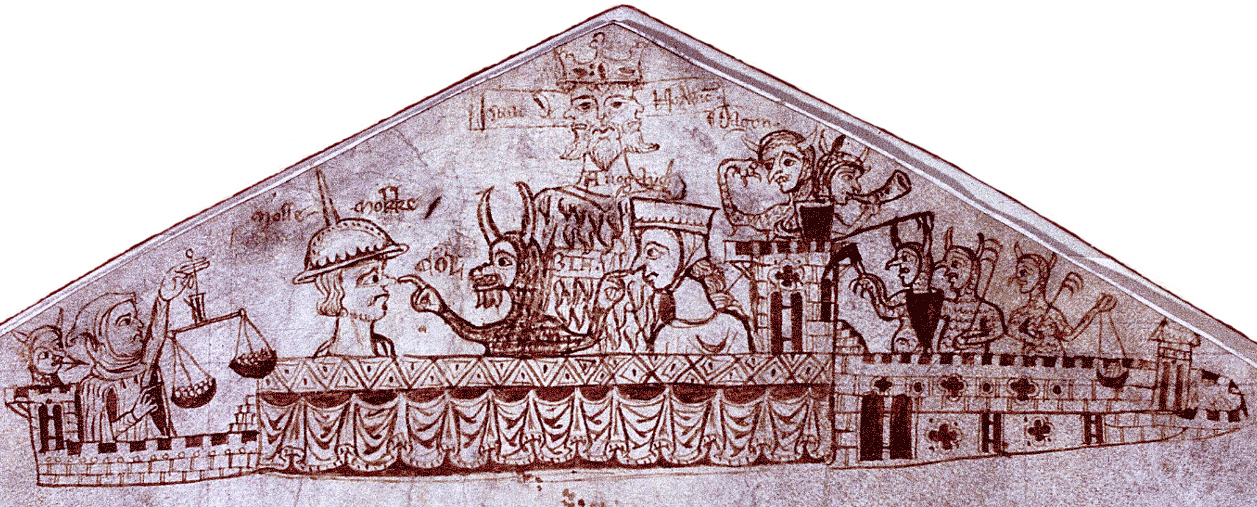
Share this image of a Medieval tax record with students. Tax records didn’t usually have pictures, but this one did. These records were documents that listed tax payments and this document records the payments made by Jewish people in the city of Norwich in Norfolk, England.
Lead the class in a short discussion about the image. Ask students what they see and what the various symbols might mean. This guide by the National Archives will help you to highlight certain aspects of the image. Help students to correctly interpret the image as anti-Jewish.
This lesson meets the following Academic Standards required by the Wisconsin Department of Public Instruction.
Before you teach, use our teacher primer to freshen up on your content knowledge.