Proclamation Inciting a Jewish Pogrom (1903)
Analyze an antisemitic document from 1903 to understand how the lie that Jews killed Jesus was used to incite violence against Jews.
Historical Context
Students will watch a clip of the 1984 German film Die Wannseekonferenz, witnessing how Nazi officials controlling various facets of German bureaucratic life worked together to make decisions surrounding the minutiae involved in organizing the genocide of 11 million people.
The Holocaust was a gradual application of violence and destruction, culminating in a meeting where the final outcome and details were meticulously planned by Nazi authorities. Almost every part of the German government was involved.
Give the students a brief overview of the lead-up to the Wannsee Conference, including a short history of the development of internment camps and ghettos. Explain that the Holocaust was a gradual process of violence and oppression; the end result of a series of events throughout the 1930s and WWII, and implemented by various groups throughout the Nazi sphere. There was no direct order signed by Adolf Hitler from the beginning. Many different people were in charge of its organization. The Wannsee Conference served to iron out details of mass extermination of the Jewish people. Despite everyone knowing what was happening, there was never a direct order for murder.
Watch the first 30 minutes of the 1984 German film Die Wannseekonferenz, available with subtitles. (Suggested stop time 31:22). Ask students to take note of details that may have surprised them, as well as key words or phrases, such as “final solution” and “Jewish question.” Stop the video at the following intervals and talk about the topics underneath, or take this time to answer any questions your students may have.
Pause movie at 10:06
Pause movie at 19:15
Lead the class in a discussion about what details may have surprised or stood out to them about the depiction of the Wannsee Conference – for example, how people casually discussed mass murder interspersed with laughter and socializing; the scene where we see one SS official paying fetch with a dog while his colleague complains that his “top secret” documents about Jewish mass killings are being circulated amongst everyone.
This lesson meets the following Academic Standards required by the Wisconsin Department of Public Instruction.
Before you teach, use our teacher primer to freshen up on your content knowledge.
Go over documents used during the Nuremberg Trials. (Some of the images contain graphic content.) Students will learn how the Nuremberg Trials came to be and the lasting impact these trials had on future cases of international injustice.
The Nuremberg Trials set the precedent that individual officials could be held responsible for “crimes against humanity” and for implementing policies that violate international law — regardless of their status as government officials.
Ask the class how they would define the terms “justice” and “accountability.” Write the words or phrases they come with on the board, then ask them the following questions:
Familiarize students with the resource, Justice and Accountability by the US Holocaust Memorial Museum. Show students that there are three sections of images and texts followed by a quote; Documenting the Crimes, The Trials, and Lasting Legacies.
Divide the class into three groups and assign them one of the three categories: Documenting the Crimes, The Trials, and Lasting Legacies and one of the quotes. These groups can end up being quite large depending on class size. Allow groups to divide up the images to go over in subgroups, as long as they all get together to discuss.
Provide the following instructions while they get into their groups:
This lesson meets the following Academic Standards required by the Wisconsin Department of Public Instruction.
Before you teach, use our teacher primer to freshen up on your content knowledge.
Students will learn the process for and the outcomes of the Nuremberg Trials.
The Nuremberg Trials were the first international war crimes trials to take place. The extenuating circumstances and the volume of people being prosecuted meant that the international courts were in unfamiliar territory. Years would go by with thousands of cases in order to bring justice to the victims of Nazi terror.
Ask students if they have heard of the Nuremberg Trials. If so, what do they know about them?
Direct students to the resource, War Crimes Trials by Echoes & Reflections. If not all students have access to a computer, print copies of the resource for your students so they can fill in the Discussion Questions worksheet on the last page.
Read through the resource as a class before having the students answer the questions on their own.
Go over the questions as a class. Did everyone come up with the same answers?
Did anything stand out to them when they read through the charges against the perpetrators?
*Hint* The term “genocide” was coined by Raphael Lemkin in 1943-44 but the crime against genocide was not put into effect until 1948.
This lesson meets the following Academic Standards required by the Wisconsin Department of Public Instruction.
Before you teach, use our teacher primer to freshen up on your content knowledge.
Critically watch a film that promotes to a broad audience the sterilization and so-called mercy killing of non-Aryans by the Nazi regime.
To pursue what the Nazis considered a “pure race of Aryans”, the Third Reich used medical techniques to sterilize and kill those they deemed undesirable.
Review the concepts of euthanasia and propaganda and allude to the fact that mercy killings had to be sold to the public in order for there not to be widespread resistance. Before initiating conversation about the video, be sure to clarify relevant terms. Other concepts that are important here include Darwinism and heredity.
Watch the first 13 minutes of the video, The Killing Films of the Third Reich. Prepare to stop at various sections to discuss and contemplate the content.
Now, ask students to generate their own responses to the video. Ask them to write about:
Then, bring the discussion back to a large group and use student answers to have a large discussion/review sections of the video.
This lesson meets the following Academic Standards required by the Wisconsin Department of Public Instruction.
Before you teach, use our teacher primer to freshen up on your content knowledge.
Students will watch videos and testimonies to learn about people’s experiences at Auschwitz and other extermination camps.
Although the primary goal of the killing centers was that- to kill- there was still a selection process where a small ratio of people were sentenced to work. The selection process and being separated from one’s family left victims traumatized.
Explain to students that there was a very distinct process that the Nazis developed to optimize the efficiency of arrivals at the camps. Ask students if any of them are aware of what this was like? Have they heard anything about the selection process before?
Watch this video by Yad Vashem to get an overview of the structure and layout of Auschwitz. Then show students video testimonies from Ellis Lewin and Eva Kor by USC Shoah Foundation iWitness.
Ellis Lewin Questions:
Eva Kor Questions:
Survivors often describe their arrival at the killing centers as a chaotic time filled with fear and uncertainty. How did listening to these two testimonies contribute to your understanding of this?
This lesson meets the following Academic Standards required by the Wisconsin Department of Public Instruction.
Before you teach, use our teacher primer to freshen up on your content knowledge.
Students will go through testimonies and photographs from the different stages people went through upon deportation to Auschwitz-Birkenau.
Auschwitz-Birkenau is often seen as the symbol of the Holocaust. All phases of getting to, and arriving at, Auschwitz-Birkenau had their own harrowing experiences.
Begin by asking your students, What was Auschwitz? What does it symbolize? What happened there? You may want to show the class a map of the Auschwitz camp by the U.S. Holocaust Memorial Museum.
Ask your students if anyone has visited the site? If someone has, ask them if they would share this experience.
Explain to students that today Auschwitz is a museum and a memorial, therefore when one enters the site today, one will not see the place as it was 60 years ago. Some buildings were preserved and others are gone; there is grass, and so on.
Direct students to the resource by Yad Vashem. Take some time to introduce your class to the site. The numbers in the left sidebar will take you to primary sources accompanying the major phases people went through while in Auschwitz. Click through pages 2-6 to show students what to expect on each page.
Divide the class into groups of three to five and assign each group a number 2-6 (number 1 is the Introduction page) and the resource page that corresponds with that number.
Provide groups with the questions corresponding to their group and give them the instructions below:
Read through the testimonies and look at the photographs for your designated section.
Prepare a presentation answering the questions that accompany your topic.
If possible, project the page for each group as they present so the entire class can see the images and testimonies that are being discussed. Present in order, having the group for Arrivals start off.
If time permits, end the class by showing students this drone footage of Auschwitz 70 years after it was liberated.
This lesson meets the following Academic Standards required by the Wisconsin Department of Public Instruction.
Before you teach, use our teacher primer to freshen up on your content knowledge.
Students will learn the basics of World War I; the participants, the outcome, and the lasting impact.
World War I (the Great War) was the first major international conflict of the twentieth century. It was known as the most destructive and devastating war of its time, costing millions in dollars and lives.
Ask the students what they already know about World War I. Try to get students thinking about this: Why is learning about World War I important when introducing the Holocaust?
Walk students through the resource World War I by the US Holocaust Memorial Museum. Start off by going over the Key Facts at the top of the page to provide students with a feel for the topic. Read through the resource as a class.
You do not need to watch the video, Path to Nazi Genocide during this lesson as it is featured in the multimedia source for World War I. If time permits, you may choose to include it in this lesson.
Divide the class into groups of three or five to discuss the Critical Thinking Questions found at the bottom of the resource page. Ask groups to designate one person to write down their answers.
Reconvene as a class to go over the student’s answers. Have groups add to their answers with notes from the classroom discussion.
This lesson meets the following Academic Standards required by the Wisconsin Department of Public Instruction.
Before you teach, use our teacher primer to freshen up on your content knowledge.
Explore the rise of Nazism in the early stages and see the road that allowed Adolf Hitler to climb the political ladder in Germany.
The rise of Nazism was aided by a depression that plagued Germany after the stock market crash of 1929, which left German citizens vulnerable to the rhetoric of a leader who promised to improve their lives.
Explain to students that Nazism became increasingly popular during the Great Depression and during a time of political crisis in Germany’s Weimar Republic. Ask your students to think critically about why they think this could be the case. What was it about the struggles of German life during this time that made the extremist views of the Nazis more appealing?
Print out the article by Facing History and Ourselves titled, Hitler in Power. Break people into small groups and have them read the page, underlining and making notes for each paragraph before moving on. After reading through, have students discuss the Connection Questions found at the bottom of the page.
After they go through the first resource, give them the resource, “Restoring” Germany’s Civil Service by Facing History and Ourselves. Let them do the same thing with this reading in their small groups. Have students go through the Connection Questions at the bottom of this page as well.
Devote approximately 15 minutes to each reading.
In an open discussion, ask students what they learned from going through the readings. What surprised them about the relationship between Adolf Hitler and President Paul von Hindenburg?
This lesson meets the following Academic Standards required by the Wisconsin Department of Public Instruction.
Before you teach, use our teacher primer to freshen up on your content knowledge.
Students will read a short Anti-Defamation League article about antisemitism in the medieval period. They will then read, analyze, and present a short primary source detailing an act or written piece of antisemitism from the medieval period.
Anti-Jewish action and antisemitism was common in the Western world since the Classical era. As time passed, superstitions and suspicions about Jewish populations reinforced hatred and persecution that continues to affect Jewish populations today. The medieval period in particular saw violence toward, and persecution of, Jewish people – especially in Christian empires.
Ask students if they know what antisemitism is, and why it’s relevant today.
Read the sections of the article by the ADL on antisemitism throughout history titled “Islamic World” and “Medieval Christendom” as a class (a unit on antisemitism more broadly could use more of the article).
Lead a class discussion on the material. Ask students:
This lesson meets the following Academic Standards required by the Wisconsin Department of Public Instruction.
Before you teach, use our teacher primer to freshen up on your content knowledge.
Students will learn about anti-Jewish attitudes that pre-dates the Holocaust by centuries.
Anti-Jewish sentiment was rife for centuries before the Holocaust, particularly in historically Christian countries and empires. Jewish life was under constant threat of violence, to the point that sometimes entire Jewish communities were massacred.
Explain that historically, anti-Jewish sentiment was a common phenomenon in the Western, Christian sphere for over a millennia. Jews were often limited in their livelihoods and where they were allowed to reside. The medieval period in particular – a time of religious crusades and conquest – was full of anti-Jewish rumours, sentiment, and action. Jews were thought to be responsible for the crucifixion, and the idea of Blood Libel (Jewish slaughter of Christian children for religious rituals) was born. At the same time, ill-treatment of Jews was not always met with sympathy. Similar to today, there were people who disapproved of the hatred and violence they faced.
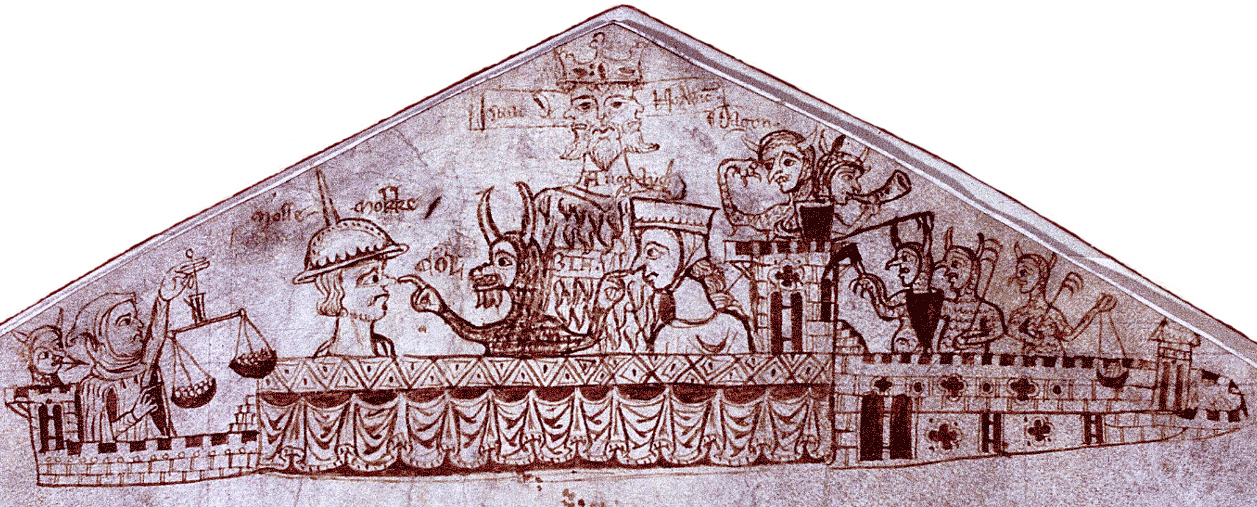
Share this image of a Medieval tax record with students. Tax records didn’t usually have pictures, but this one did. These records were documents that listed tax payments and this document records the payments made by Jewish people in the city of Norwich in Norfolk, England.
Lead the class in a short discussion about the image. Ask students what they see and what the various symbols might mean. This guide by the National Archives will help you to highlight certain aspects of the image. Help students to correctly interpret the image as anti-Jewish.
This lesson meets the following Academic Standards required by the Wisconsin Department of Public Instruction.
Before you teach, use our teacher primer to freshen up on your content knowledge.