Some Were Neighbors
Explore an online exhibition from the United States Holocaust Memorial Museum titled, “Some Were Neighbors.” Students will look into the different categories of collaborators that assisted in carrying out the Holocaust.
Students will read a short Anti-Defamation League article about antisemitism in the medieval period. They will then read, analyze, and present a short primary source detailing an act or written piece of antisemitism from the medieval period.
Anti-Jewish action and antisemitism was common in the Western world since the Classical era. As time passed, superstitions and suspicions about Jewish populations reinforced hatred and persecution that continues to affect Jewish populations today. The medieval period in particular saw violence toward, and persecution of, Jewish people – especially in Christian empires.
Ask students if they know what antisemitism is, and why it’s relevant today.
Read the sections of the article by the ADL on antisemitism throughout history titled “Islamic World” and “Medieval Christendom” as a class (a unit on antisemitism more broadly could use more of the article).
Lead a class discussion on the material. Ask students:
This lesson meets the following Academic Standards required by the Wisconsin Department of Public Instruction.
Before you teach, use our teacher primer to freshen up on your content knowledge.
Students will watch a short film about the idea of Blood Libel. To accompany this video, students will read short stories about how Blood Libel was used to blame Jews for incidents in the community.
Blood libel grew out of an ancient accusation and has been carried by antisemitic ideology for centuries.
Lead a short 5-minute discussion about antisemitic ideas commonly found today. Examples of topics include the ideas that Jews killed Jesus, Jews control money and the media, Jews have split-loyalty to Israel, and blood libel.
Watch the short film about blood libel by Facing History and Ourselves.
In small groups of 3-5, have students read the four contemporary short stories of blood libel. Ask the groups to take notes on similarities in each story.
Lead a class discussion on blood libel. Ask the students what similarities and differences they found within the stories they read, and what they thought reactions by local Christians were to accusations of blood libel. In particular, make sure to point out the fact that most of these stories are recorded by poets and folklorists – not necessarily told as first-hand accounts. Ask students why they think people believe in blood libel, and how dangerous and powerful a lie can be as it persists over time.
Before you teach, use our teacher primer to freshen up on your content knowledge.
Students will learn about anti-Jewish attitudes that pre-dates the Holocaust by centuries.
Anti-Jewish sentiment was rife for centuries before the Holocaust, particularly in historically Christian countries and empires. Jewish life was under constant threat of violence, to the point that sometimes entire Jewish communities were massacred.
Explain that historically, anti-Jewish sentiment was a common phenomenon in the Western, Christian sphere for over a millennia. Jews were often limited in their livelihoods and where they were allowed to reside. The medieval period in particular – a time of religious crusades and conquest – was full of anti-Jewish rumours, sentiment, and action. Jews were thought to be responsible for the crucifixion, and the idea of Blood Libel (Jewish slaughter of Christian children for religious rituals) was born. At the same time, ill-treatment of Jews was not always met with sympathy. Similar to today, there were people who disapproved of the hatred and violence they faced.
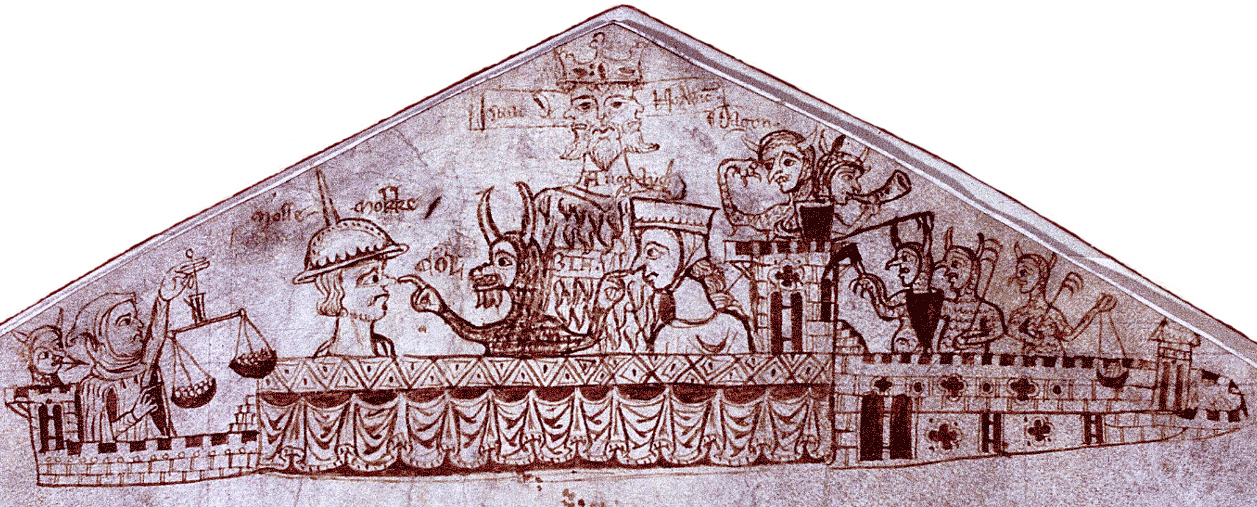
Share this image of a Medieval tax record with students. Tax records didn’t usually have pictures, but this one did. These records were documents that listed tax payments and this document records the payments made by Jewish people in the city of Norwich in Norfolk, England.
Lead the class in a short discussion about the image. Ask students what they see and what the various symbols might mean. This guide by the National Archives will help you to highlight certain aspects of the image. Help students to correctly interpret the image as anti-Jewish.
This lesson meets the following Academic Standards required by the Wisconsin Department of Public Instruction.
Before you teach, use our teacher primer to freshen up on your content knowledge.